
Not long ago, many school districts believed they were moving beyond charging carts.
As 1:1 take-home programs became more common, students charged devices at home, classrooms became less dependent on centralized charging. Many districts retired—or simply stopped purchasing—charging carts altogether. Others still have older charging carts in storage, even though the charging technology inside them no longer meets the needs of today's USB-C devices.
Today, that trend is beginning to reverse.
Across the country, districts are once again investing in classroom charging infrastructure as device programs evolve. For example, in June 2026, the Los Angeles Unified School Board approved approximately $4 million for 3,100 mobile charging carts as part of its screen time limit initiative, illustrating that charging carts remain an important part of modern classroom technology planning.
Modern charging technology has evolved significantly, giving schools new ways to manage devices without the maintenance headaches that defined earlier generations of charging equipment.
Why Charging Carts Are Back on the Planning Agenda
Several factors are driving renewed interest in classroom charging infrastructure.
Changing conversations around student screen time, evolving instructional models, and growing interest in keeping more devices on campus are prompting many districts to rethink how devices are stored and charged.
For some schools, the conversation is no longer about every student taking a device home. It's about returning laptops to charging carts instead of students at the end of the day, ensuring devices are securely stored, fully charged overnight, and ready for instruction the next morning. As more districts adopt shared classroom sets, in-class-only deployments, or hybrid 1:1 models, dependable overnight charging becomes an increasingly important part of technology planning.
As a result, schools are increasingly planning for:
- Shared classroom device sets
- More overnight charging capacity
- Secure on-campus device storage
- Consistent device readiness each morning
- Charging infrastructure that supports multiple deployment models
Charging carts are once again becoming an important part of district technology planning—not because schools are returning to the past, but because operational needs have changed.
Why Many IT Teams Still Dread the Word "Charging Cart"
Mention charging carts to many veteran technology directors, and you'll often hear stories about tangled cables, missing power adapters, and hours spent troubleshooting charging problems.
Those experiences were real.
Many legacy charging carts relied on:
- Individual AC power adapters for every device
- Bulky cable bundles
- Time-consuming setup
- Frequent charger replacements
- Complex cable management
- Higher maintenance demands
For IT teams responsible for hundreds or thousands of student devices, maintaining those systems could become almost as challenging as managing the devices themselves.
It's no surprise that many districts were happy to move away from them when take-home programs became the norm.
 What's Changed Since Then?
The biggest difference between today's best charging carts and the ones many districts remember isn't the charging connector—it's how they manage power.
Older charging carts often forced IT teams to work around the limitations of the charging system. AC adapters required constant maintenance, devices had to be charged in stages, timers were used to prevent overloaded circuits, and adding additional carts sometimes required electrical upgrades.
JAR Systems' Quick-Sense™ USB-C Charging Technology provides continuous power throughout the charging cycle, eliminating the need for timer programming, charging schedules, or manual power cycling. Rather than requiring IT staff to manage when devices charge, Quick-Sense™ intelligently distributes power so devices charge reliably throughout the night.
Modern USB-C PD Carts Don’t Need AC Adapters
A major reason today’s charging carts are easier to manage is simple: no more individual AC adapters. Legacy carts required a separate power brick for every device, creating cable clutter, setup time, and a steady stream of replacements.
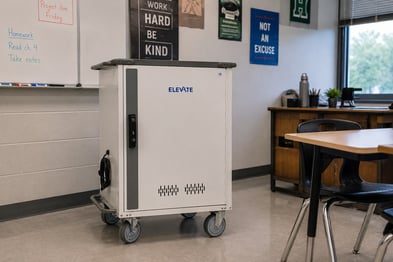
With built‑in USB‑C charging—like the dual coiled cables used in Elevate USB-C Charging Carts—carts arrive ready to use. IT teams no longer spend hours wiring chargers, tracking missing adapters, or replacing expensive bricks. When a cable wears out, a standard USB‑C cable solves the problem.
Removing AC adapters cuts:
- Maintenance, by eliminating the most failure‑prone component
- Ongoing costs, since districts no longer buy and replace individual chargers
- Setup time, because carts don’t require wiring sessions or cable routing
It’s a small change with a big operational impact—one that makes modern charging carts far easier to deploy and support.
Charging Without Timers
Many legacy charging carts relied on timer-based charging or power cycling to stay within available electrical capacity. If devices weren't completely powered down before being returned, batteries could continue draining after charging stopped—resulting in partially charged devices the next morning.
Elevate EDU and Elevate Air EDU are powered by JAR Systems' proprietary Quick-Sense™ USB-C Charging Technology, which uses intelligent power management to deliver continuous charging without requiring timer programming or charging schedules.
No Charging Order to Manage
Some charging systems required devices to be plugged in according to a specific sequence or charged in rotating groups.
Quick-Sense™ USB-C Charging Technology automatically manages power distribution, eliminating the need for teachers or IT staff to think about charging order or manually balance power across devices.
Instead of managing the charging process, staff simply connect devices and let the system do the work.
Designed Around Real Classroom Power Limits
One of the biggest challenges districts face when expanding charging infrastructure isn't purchasing the carts—it's determining whether existing classrooms can support them electrically.
Powered by Quick-Sense™ USB-C Charging Technology, Elevate EDU and Elevate Air EDU are engineered to maximize available circuit capacity, providing the electrical headroom needed to deploy high-capacity charging without the timer-based workarounds common in older systems.
Charging That Requires Less Attention
The best charging system is one teachers and IT staff rarely have to think about.
Features such as LED charging indicators, Quick-Sense™ intelligent power management, and dual USB-C coiled cables simplify day-to-day operation by making device status easy to verify, reducing cable clutter, and eliminating many of the maintenance tasks traditionally associated with classroom charging.
The result isn't simply faster charging—it's a charging system designed to reduce IT workload while ensuring devices are ready whenever instruction begins.
Five Questions That Separate Modern Charging Carts
If your district is evaluating new charging infrastructure, focus on the operational details that will affect day-to-day management—not just product specifications. The right questions can reveal important differences between charging solutions that may not be obvious in a feature list.
Does the charging system maximize available circuit capacity?
Not all charging carts use available electrical power the same way. Look for solutions designed to provide sufficient circuit headroom without relying on workarounds like timers or charging cycles, helping schools expand charging capacity without unnecessary electrical modifications.
Does it require timers or provide continuous charging?
Some charging carts still rely on timer-based charging or power cycling to stay within electrical limits. Others use intelligent power management—such as JAR Systems' Quick-Sense™ USB-C Charging Technology—to provide continuous charging without programming timers or managing charging schedules.
How easy is it to service and maintain?
Routine maintenance shouldn't require removing every device from the cart. Consider whether charging hubs and serviceable components are easily accessible, allowing IT staff to perform maintenance quickly and minimize classroom downtime.
Are replacement cables standardized or proprietary?
Charging cables are among the most frequently replaced components in any charging cart. Determine whether the system uses standard USB-C cables that are easy to replace or proprietary cables that may increase long-term maintenance costs and procurement complexity.
 Could your existing charging carts be upgraded instead?
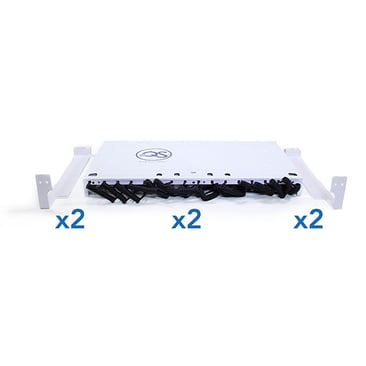
Not every district needs to purchase entirely new charging carts. If your school already owns charging carts with solid cabinets and locking hardware, solutions like JAR Systems' Quick-Sense™ USB-C Charging Retrofit Kits can modernize compatible Bretford, Spectrum, Anywhere Cart, Vivacity, and legacy JAR carts, extending their lifespan while bringing them up to today's USB-C charging standards.
Modern Charging Carts Support More Than Charging
Today's charging carts do much more than recharge batteries.
They help districts:
- Organize classroom devices
- Simplify overnight charging
- Reduce charging-related maintenance
- Improve device readiness each morning
- Support mixed-device environments
- Prepare for future technology changes
JAR Systems' Elevate EDU and Elevate Air EDU charging carts bring Quick-Sense™ USB-C Charging Technology into the classroom, combining intelligent power management, efficient USB-C charging, and simplified maintenance in a single platform. Rather than requiring schools to work around the limitations of legacy charging systems, Quick-Sense™ is designed to make charging predictable, reliable, and largely invisible to teachers and IT staff.
The result is infrastructure that supports both today's classrooms and tomorrow's technology decisions.
Looking Beyond the Cart
As districts revisit on-campus charging, it's important to remember that charging carts are only one part of a broader infrastructure strategy.
Some classrooms may benefit from centralized overnight charging, while others may also incorporate at-the-desk charging or portable power to support instruction throughout the day.
The most successful districts evaluate charging based on how devices are actually used—not on the assumption that every solution must be purchased new. In many cases, modernizing existing charging carts with USB-C retrofit technology can be just as effective as investing in new infrastructure.
Charging carts remain an important foundation, but they're most effective when integrated into a flexible charging strategy designed around the needs of students, teachers, and IT teams.
The next generation of charging carts isn't about recreating the past—it's about choosing charging infrastructure that reduces IT workload, supports future device refreshes, and fits the realities of today's classrooms.
Before making your next investment, download JAR Systems' Buyer's Guide: 25 Questions to Ask When Evaluating Device Charging Solutions. It provides a practical framework for comparing charging technologies, maintenance requirements, scalability, and long-term operational costs—so you can make a more informed decision for your district.